
Why Does AIoT Matter?
AIoT (Artificial Intelligence of Things) matters because it goes beyond IoT’s ability to connect and monitor devices—it adds intelligence. While IoT collects and shares data, AI makes sense of it in real-time, enabling prediction, automation, and autonomous decision-making.
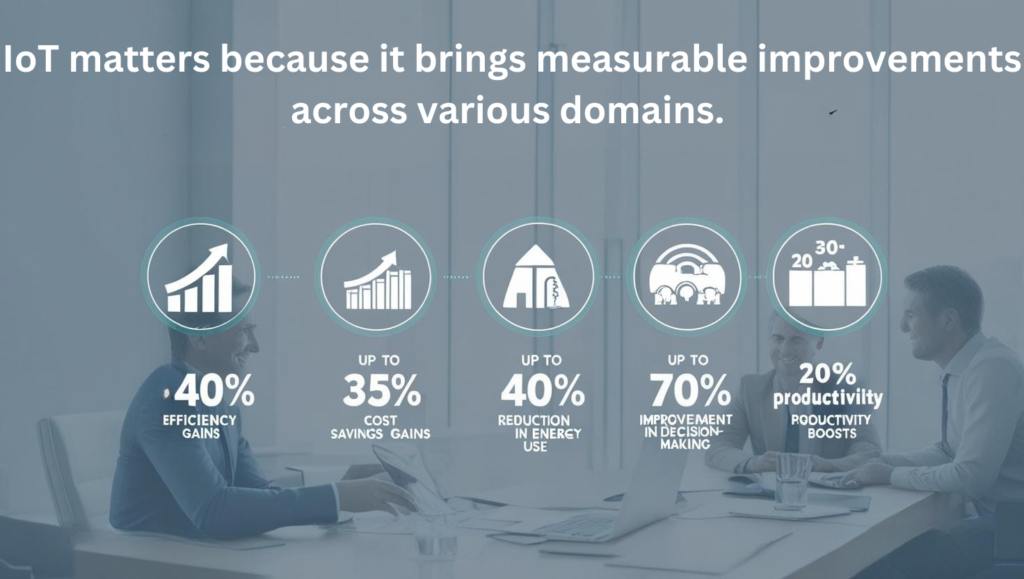
It creates tangible results such as:
- 50% Efficiency Gains through intelligent automation.
- 40% Cost Savings by optimizing resources and predicting failures.
- 45% Reduction in Energy Use with smart optimization algorithms.
- 80% Smarter Decisions via AI-driven predictive analytics.
- 25% Productivity Boost with autonomous workflows and self-learning systems.

What are the Benefits of AIoT?
AIoT delivers deeper, long-term benefits compared to IoT alone:
- Operational Efficiency: AI enhances automation, adapting workflows dynamically.
- Predictive Maintenance: AI detects patterns and predicts breakdowns before they happen.
- Cost Reduction: Optimizes energy, labour, and maintenance through smarter decisions.
- Real-Time Intelligence: Devices don’t just send data—they interpret it instantly.
- Enhanced Customer Experience: Personalization powered by AI insights.
- Data-Driven Insights: Predictive analytics improves planning, forecasting, and risk control.
How Does AIoT Impact Business?
AIoT reshapes businesses by making IoT data actionable in real time:
- Intelligent Automation: Self-optimizing workflows reduce costs and improve speed.
- Smarter Decisions: AI models analyze IoT data for deeper insights.
- Supply Chain Intelligence: Predict delays, optimize routes, and automate logistics.
- Energy Optimization: AI algorithms balance loads and reduce wastage.
- Proactive Customer Service: AI chatbots, predictive alerts, and smart recommendations.
- Competitive Advantage: Businesses innovate faster with AI-driven products and services.

How Does AIoT Work?
AIoT enhances the IoT 4-step process by adding intelligence at every stage:
- Sensors & Devices – Capture physical data.
- Connectivity – Transmit via Wi-Fi, 5G, LPWAN, etc.
- AI Data Processing – AI/ML models process and predict outcomes (cloud or edge).
- Actionable Outcomes – Autonomous responses, optimized actions, predictive alerts.
What is an AIoT Platform?
An AIoT platform is the next-gen backbone of smart ecosystems, enabling:
- Device Connectivity & Management – Seamlessly manage IoT networks.
- AI-driven Analytics – Apply machine learning models to raw IoT data.
- Predictive Intelligence – Anticipate events before they occur.
- Smart Visualization – Dashboards enriched with AI insights, anomaly detection, and forecasting.
- Automation & Autonomy – Trigger workflows that improve themselves over time.


Things to Look for in an AIoT Platform
When selecting, ensure it has:
- Security: AI-enabled threat detection with IoT-grade encryption.
- Scalability: Ability to process millions of devices and AI models.
- Advanced Analytics: Predictive & prescriptive AI, not just reporting.
- Edge AI Integration: Run intelligence closer to devices for faster response.
- Easy Integration: Compatibility with enterprise systems and APIs.
- Community & Support: Strong AI + IoT developer ecosystem.
How Fast Can I See Results After AI-powered EMS Deployment and Can the AI-powered EMS Integrate with My Existing Energy Meters?
With AI built into EMS, results come even faster and smarter:
- Immediate Savings – AI instantly detects hidden energy wastage.
- Quick Wins – Automated recommendations optimize operations right away.
- 3–6 Months – AI-driven analysis unlocks predictive savings through load forecasting, demand-response, and self-optimizing controls.
- 6–12 Months – Many customers achieve accelerated ROI with continuous AI-based improvements.
Yes. Integration is smarter and smoother:
- Standard Protocols + AI Adapters – Works with Modbus, MQTT, and more—even learning patterns from legacy devices.
- Device Compatibility – Smart meters, IoT sensors, legacy equipment—all unified with AI-driven normalization.
- Infrastructure-Friendly – AI bridges data gaps, letting you use what you already have while enhancing insights.


Is the AI-powered EMS Scalable for Future Growth and How Secure is the AI-powered EMS Platform?
Absolutely—it doesn’t just scale, it anticipates growth:
- Adaptive Expansion – Add new devices, sites, or assets; AI auto-calibrates without manual setup.
- Cloud + Edge Intelligence – AI runs at both device (edge) and cloud level for real-time and large-scale optimization.
- Multi-Site Learning – AI compares performance across locations and shares best practices globally.
Security is stronger with AI-driven defines:
- End-to-End Encryption – Protects all data streams.
- Adaptive Threat Detection – AI identifies anomalies in energy data that may signal cyber intrusions.
- Smart Access Controls – AI enforces role-based permissions and flags unusual login activity.
- Continuous Cyber Audits – AI models monitor and respond to evolving threats.
Features of AIoT
- Remote Monitoring with AI Insights
- Autonomous Automation (not just rules, but adaptive intelligence)
- Predictive & Prescriptive Analytics
- Cross-Device Interoperability
- Edge + Cloud AI (real-time local + scalable cloud intelligence)
- Smart Alerts (AI-powered anomaly detection, not just thresholds)


AIoT Solutions by Industry
- Smart Energy: AI-driven load forecasting, demand-response, and efficiency.
- Industrial AIoT (IIoT): Predictive maintenance, defect detection, production optimization.
- Smart Cities: AI for traffic prediction, waste management, public safety.
- Healthcare AIoT: AI-driven diagnostics, remote monitoring, personalized care.
- Agriculture AIoT: AI-based crop health monitoring, smart irrigation, yield prediction.
- Retail AIoT: Customer behaviour analytics, dynamic pricing, and automated inventory management.